In a society where consumption is faster and more accessible every day, proper waste disposal and management is an increasingly important issue. Costa Rica currently produces around 4,000 tons of waste a day, the equivalent of the weight of 300 buses, according to Health Ministry data.
To deal with this, private as well as public stakeholders are driving change and seeking joint solutions for proper waste management to mitigate and reduce the impact of this waste on the environment, health, and natural resources.
With this motivation, studies were carried out in the design stage of Universal Tower on the dimensions that would be needed for waste management, based on the national metrics of other corporate centers, in order to visualize the number of kilograms that would be generated.
In addition, the assets that would be needed for the entire waste management process to operate properly, such as collection centers, fittings, containers, platforms, operators, etc., were established at the start of the operation.
Integrated Waste Management Program (IWMP)
Universal Tower now has an integrated waste management program (IWMP) in place that specifies the types of waste being managed, authorized waste managers, risk matrix, identified weaknesses and challenges of the risk prioritization, and other points for continuous improvement of the scope of waste reuse and valorization.
Benefits of effective waste management
A smaller environmental footprint (since with proper management the waste is separated and valorized and the amount going into the landfill is significantly reduced), more efficient resource use, and reduced greenhouse gas (GHG) emissions are some of the main benefits of implementing an effective waste management system in a corporate building.
Main challenge
The main challenge for integrated waste management in the buildings is motivating all tenants to manage and help reach the common goals of reducing, separating, and valorizing.
Five keys to proper waste management in corporate buildings
Separate all waste according to their source: organic, recyclable (plastics, tetra, cardboard, aluminum, srap metal, paper, and glass), special handling waste (electric and electronic devices), hazardous and/or biohazardous waste (if any), and ordinary or non-valorizable waste.
Track waste management weight data to obtain a baseline of the waste being generated and keep track of the percentage that will go into the landfill.
Implement the integrated waste management program (IWMP) to have proper tracking of the data on generated waste and authorized managers.
Assess and ensure that the authorized team properly manages the waste according to its type: The project should be committed to ensuring that waste is properly treated and valorized.
Train personnel: Inform project users of proper waste management and treatment and explain its importance for mitigating climate change.
According to the OECD’s 2020 Costa Rica economic study, Costa Rica recycles or valorizes some 6.6% of its waste.
Results at Universal Tower
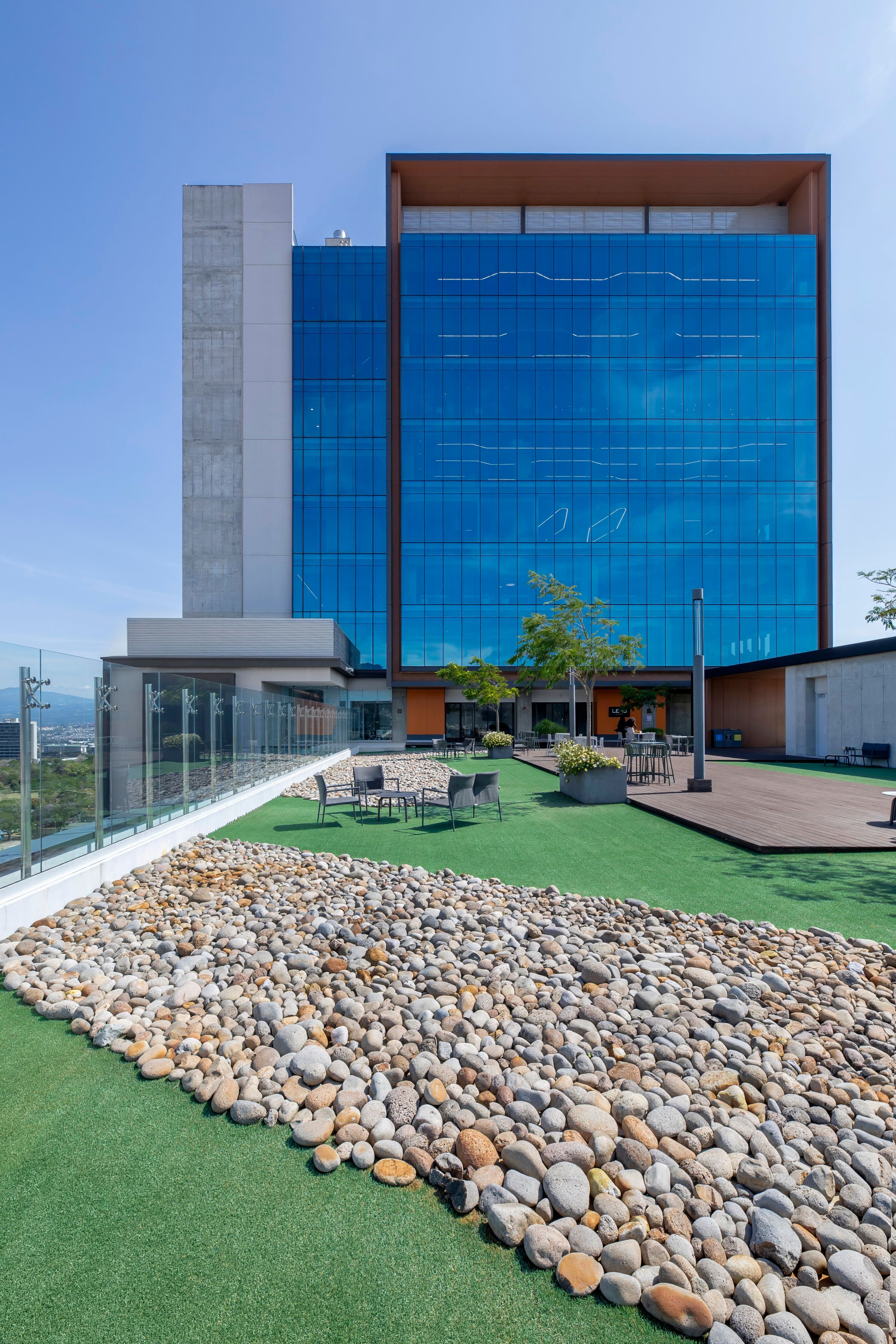
Universal Tower is an exemplary corporate building. During 2022, it valorized 31% of the waste material, divided into 20% valorizable and 11% organic. This achieved a GHG reduction in landfills of more than 14 tons of carbon dioxide (CO2), equivalent to approximately one-half hectare with ten years of tree growth, according to the EPA (US Environmental Protection Agency).
Legal framework
The main legal aspect to take into account is Law 7784 (Integrated Waste Management Act), the goal of which is to regulate waste management and efficient resource use through the planning and implementation of regulatory, operational, financial, administrative, educational, environmental, and healthy monitoring and assessment actions.
Sustainability strategy
These actions are in line with Portafolio Inmobiliario’s sustainability strategy in the circular operations area under the material topic of integrated waste management, since the developer has committed to measuring all waste generated in each project in order to set a baseline and reduce all generated waste by 20% and valorize at least 30% of all waste.